Table of Contents
Highlights
- Data analytics costs vary widely depending on company size, team structure, technology stack, and analytical complexity.
- In-house teams provide full control but come with high salaries, recruitment, training, technology, and management overhead.
- Outsourcing or fractional analytics teams offer scalable access to senior-level expertise without the upfront investment or ongoing operational burden of a full-time team.
- Project scope, data volume, tools, governance, and reporting requirements all significantly impact total analytics costs.
- Fractional teams can deploy dashboards, pipelines, and reports faster, reducing ramp-up time and accelerating ROI.
- Choosing the right analytics model—internal, consulting, hybrid, or fractional—helps businesses balance cost, speed, and expertise for optimal decision-making.
Data analytics has quickly moved to the forefront of business strategy. Across industries, leaders increasingly turn to guide decision-making, forecasting, and long-term strategy. In fact, eight in 10 business leaders told Salesforce data is “critical” in decision-making with 73% planning to “continue or increase spending on data skills.”
But while everyone wants to make their business data driven, not every team has the technical chops to get there. Per Salesforce’s survey of almost 10,000 business leaders, four in 10 (41%) say they “lack understanding of data because it’s complex or not accessible enough.”
For many, that knowledge gap extends to data analytics costs, as leaders often underestimate what it takes to build and maintain reliable reporting and insights.
Estimating data analytics costs is challenging in part because expenses can vary dramatically depending on team structure, technology stack, data infrastructure, and the scope of analysis required. Plus, there are multiple data analytics pricing models.
In this blog post, learn what factors influence data analytics cost, the cost of building an in-house data analytics team, and different options to outsource data analytics.
Data Analytics Cost by Business Size
The cost of data analytics can vary significantly depending on your business’s reporting needs, the number of data sources you manage, infrastructure maturity, and overall analytical complexity.
Business size also plays a key role in determining analytics requirements:
- Small businesses (1-50 employees) often need to centralize data from a handful of systems (e.g., CRM platforms, marketing tools, financial software) and build foundational analytics capabilities like dashboards or reporting.
- Mid-market companies (51-500 employees) typically require deeper analytics integration, such as integrating more business applications (data sources).
- Enterprises (500+ employees) usually look for highly scalable analytics infrastructure with advanced data pipelines, governance frameworks, machine learning models and enterprise-wide reporting.
No matter your size, you can opt for an in-house data analytics team or take an outsourced approach, but some options make more sense depending on your company’s scope and resources.
For example, if you’re a small or mid-market company, a fractional data analytics team gives you immediate access to senior-level expertise without requiring large, upfront investments in hiring or technology.
Internal teams might give greater control, but they also come with bigger costs and commitments for hiring, training, infrastructure, and management.
The table below compares typical monthly costs of different data analytics team models:
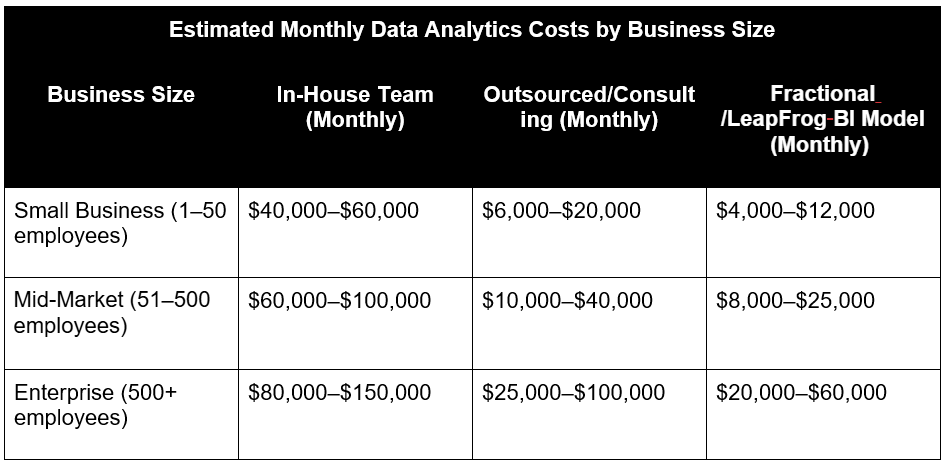
Source: Estimated ranges based on consulting rate benchmarks from Clutch.
What’s behind these pricing discrepancies?
- In-house analytics teams require multiple specialized roles, such as data engineers, data analysts, and data scientists, which makes payroll costs snowball fast.
- Analytics consulting firms often charge by the hour, which can quickly escalate as projects expand or timelines change.
- Fractional models provide access to experienced analytics specialists without requiring full-time hires or unexpected overtime fees.
What Factors Influence Data Analytics Cost?
While business size is a good starting point to estimate data analytics cost, it doesn’t tell the whole story. You also have to look at project scope, data volume, technology infrastructure, governance requirements, and reporting needs.
1. Project Scope
Naturally, the bigger your company and the more complex your operations, the more analytic capabilities you need—and the bigger your data analytics costs will be.
But size isn’t everything. Small companies with complex data environments or multiple sales channels may still need advanced analytics, while larger companies may just seek basic reporting if they already have established data infrastructure in place.
Common analytics projects include:
- Building dashboards and reporting systems
- Creating data pipelines to connect multiple systems
- Developing forecasting or predictive models
- Automating reporting workflows
Each additional task increases development time, infrastructure needs, and maintenance costs. While you might be able to get up and running with a simple reporting dashboard in just a few weeks, enterprise-scale projects can require months of work. And as scope expands, so does cost.
2. Data Volume
Another major cost driver is the amount of data your organization generates and stores.
With large volumes of data coming from multiple systems (e.g., CRM platforms, e-commerce tools, marketing software, ERP systems, etc.), it takes more tech and processing power to effectively analyze all that information. That means higher costs for storage, compute, and data management. Remember:
- Large datasets require scalable cloud infrastructure
- Storage costs accumulate over time
- Processing large datasets increases compute costs
- Real-time analytics adds further infrastructure demands
3. Tools, Software, and Licensing
Technology costs, of course, come into play when prepping data analytics capabilities, especially for organizations trying to build an entire in-house data analytics department from scratch.
Doing so requires onboarding multiple technologies to store, process, analyze, and visual data, such as:
- Data warehouses or data lakes to centrally store structured and unstructured data
- Data integration and pipeline tools to extract, transform, and move data between systems
- Business intelligence and dashboarding platforms to analyze data and create visual reports
- Data governance and monitoring systems to ensure data quality, accuracy, and compliance
- Orchestration and automation tools to schedule, manage, and maintain data workflows
Where in-house data analytics teams must carry the full burden of purchasing, configuring, and maintaining a full suite of technologies, organizations that choose to work with a fractional data analytics team get the same capabilities without the overhead, responsibility, or commitment of managing an entire technology stack.
4. Governance Requirements
Poor data quality is the ultimate thorn in a data analytics team’s side. Unfortunately, it’s a common challenge: Forty-three percent of chief operations officers call data quality issues their most significant data priority, per a 2025 report from the IBM Institute for Business Value.
And that it should be. The same report found that “over a quarter of organizations estimate they lost more than $5 million annually due to poor data quality, with 7% reporting losses of $25 million or more.”
If your data is inconsistent, incomplete, duplicated, or poorly structured, you need to get it in tip-top shape ASAP—but it will cost you. Data clean-up is a complex process that requires significant time, tools, and skill to:
- Standardize data formats
- Resolve duplicate records
- Validate metrics and calculations
- Define consistent business logic
- Establish data governance policies
And every step requires additional time and expertise, ultimately increasing your overall data analytics cost.
Poor data quality is a main reason AI initiatives fail when moving from pilot to production. Follow this checklist to see if your data is ready for AI.
5. Reporting and Visualization Needs
At the end of the day, data only becomes valuable for decision-making, forecasting, and strategy if you and your team have a way to access and interpret it.
Depending on your business goals, you may require different analytics outputs to support decisions, like:
- Executive dashboards
- Operational performance reports
- Sales and revenue reports
- Customer segmentation and marketing analytics
- Forecasting and predictive models
- Financial reporting dashboards
Some visualizations are more complex than others, stretching out development time and contributing to your final data analytics cost. Highly customized dashboards, for example, often require extensive development and testing.
Don’t forget: Dashboards aren’t a set-it-and-forget-it. You’ll also need to consider ongoing monitoring and maintenance to ensure reports and dashboards remain accurate and trustworthy as systems evolve.
The Cost of Building an In-House Data Analytics Team
Once organizations decide they’re ready to get on board with data analytics, they typically start planning to build an internal team. But while going in house can be the right choice for some businesses, it’s not always the most practical option.
Many leaders underestimate the time, effort, and investments required to hire, train, manage, and retain a functional analytics department.
Often, salaries are the first expense that comes to mind—but they’re only a small piece of the puzzle. Other costs include:
- Recruiting: Finding top-tier talent in a competitive market requires sourcing qualified candidates, interviewing, and onboarding new hires.
- Retention: It takes competitive pay packages, including benefits and career development opportunities, to retain in-demand analytics talent.
- Technology: Beyond talent, an in-house data analytics team requires infrastructure, data platforms, and reporting tools.
- Management: Running a full-time analytics department adds responsibilities for project management, team leadership, and coordination with other departments.
Salaries don’t paint the whole picture, but they do offer a glimpse at how quickly data analysis costs can accumulate. In the United States, the national average salary for a data engineer is $165,018; data scientists average around $122,738 and data analysts about $82,640.
And these numbers don’t account for the time and effort leadership will have to spend managing analytics initiatives instead of focusing on core business operations.
Still think you want to build in house? See what it takes to build an effective data analytics team.
Outsourcing Data Analytics: Costs and Benefits
With the steep expenses, commitment, and management responsibilities of building an in-house data analytics team, more businesses (from small firms to large-scale enterprises) are looking to data analytics partners to outsource analytics work.
These are top three data analytics pricing models:
Consulting and Project-Based Pricing Models
What it is: Consulting firms typically focus on specific analytics projects, like:
- Building a data warehouse
- Implementing a reporting platform
- Migrating analytics infrastructure
- Developing predictive models
Who it’s for: Organizations seeking help with a one-off analytics task.
Cons:
- Often high hourly rates that may increase if project scope changes
- Limited long-term support
- Projects may require additional consulting engagements for maintenance or updates
Hybrid
What it is: A hybrid model combines in-house analytics employees with external support.
Who it’s for: Organizations that want to maintain some internal analytics capacity while supplementing a small team with expertise from outside specialists.
Cons:
- Complicates management, scheduling, and coordination
- Introduces opportunities for miscommunication between in-house and external teams
- Risks potential duplication of effort or integration challenges between internal and external systems
Fractional Analytics Teams (LeapFrogBI’s approach)
What it is: A fractional data analytics team gives you on-demand, scalable access to a full team of data analytics experts.
Who it’s for: Organizations that need analytics expertise but don’t want the cost or commitment of building a full-time internal team.
Pros:
- Eliminates need to hire, retain, and pay full-time employees
- Optimizes resource use by paying only for what you need, when you need it
- Gives your company access to industry experts without a full-time commitment
What can you expect when outsourcing data analytics?
How LeapFrogBI Lowers Data Analytics Costs
When you work with LeapFrogBI, you can tap into advanced analytics capabilities without the cost or operational burdens of building an in-house team of full-time data specialists.
Instead, you get scalable, on-demand, access to a full data analytics team, so you can begin using your data to power faster, smarter decision-making while still controlling analytics costs.
You’ll also get to:
- Pay only for the expertise you need: You get access to senior-level analytics professionals without committing to full-time salaries.
- Eliminate infrastructure and licensing overhead: Infrastructure and analytics software licenses are fully managed, removing upfront technology costs.
- See faster deployment and ROI: On-demand analytics expertise means you can instantly start building data pipelines, dashboards, and reports without wasting time recruiting, hiring, and training new full-time employees.
- Enable continuous optimization: Our fractional analytics team can actively monitor and modify data models, reporting logic, and dashboards to ensure accurate analytics as your business grows.
How Medex uncovered nearly $1 million annually in lost billing with LeapFrogBI
Challenge: Medex had rapidly growing datasets that exceeded Excel’s capabilities, leaving valuable data unused and forcing teams to spend time preparing data instead of analyzing.
LeapFrogBI Solution: Our fractional data analytics team built a data warehouse and developed Power BI reporting systems to automate revenue cycle analytics and common accounting tasks.
Results: The new analytics platform revealed nearly $1 million annually in lost billing, automated manual processes, and allowed Medex’s team to focus on more strategic business activities.
Read the full story to see how LeapFrogBI uncovered hidden revenue for Medex with data analytics.
The Bottom Line
Data analysis costs can vary widely depending on your infrastructure, team structure, and analytical complexity—but no matter your company size, building in house often comes with significant financial and operational commitments.
When you decide to recruit, hire, train, and manage a full-time data analytics department, you sign up for large investments in salaries, technology, and management, both upfront and ongoing. Consulting services, on the other hand, can help with one-off projects but can quickly spiral in cost if scope expands.
Only a fractional data analytics team gives you a practical middle ground: on-demand access to data analytics expertise; scalable support; predictable costs.
Common FAQs
How much does a typical data analytics project cost?
A typical data analytics project can cost from $10,000 to $100,000+ with the ultimate price tag varying greatly depending on your company size, project scope, data volumes, and technology, governance, and reporting requirements. As a general rule of thumb, projects involving many data sources and custom dashboards tend to cost more than simple reporting implementations.
What are the hidden costs of data analytics?
Hidden costs in data analytics often include unexpected data cleaning, software licensing, and ongoing maintenance. Many organizations also underestimate how much time and effort go into hiring, training, and managing in-house data analytics teams.
How do you budget for data analytics?
To estimate data analytics cost, consider your project goals, infrastructure requirements, reporting needs, and number of data sources. If you’re unsure how to structure your analytics environment for optimal performance and costs, schedule a data analytics consultation.